

SEO Training Online: Live Coaching vs Self-Paced — Which SEO Course Is Right for You?
When you start exploring SEO training online, one question comes up quickly: should you work with a live SEO coach, or find a self-paced SEO course you can complete on your own schedule?
Both can help you learn SEO. The real question is which format takes you from understanding SEO basics to applying what you know — on your real website, for your actual business goals. Whether you are a complete beginner or someone with existing SEO knowledge looking to go deeper into advanced SEO, the format you choose has a direct impact on how quickly you make progress.
This article gives you an honest look at both options, including what the best SEO courses include and how to decide which path makes sense for you.
Table of Contents
Two Ways to Learn SEO Online
Before getting into the comparison, here is what each format actually involves.
What Is Live SEO Coaching?
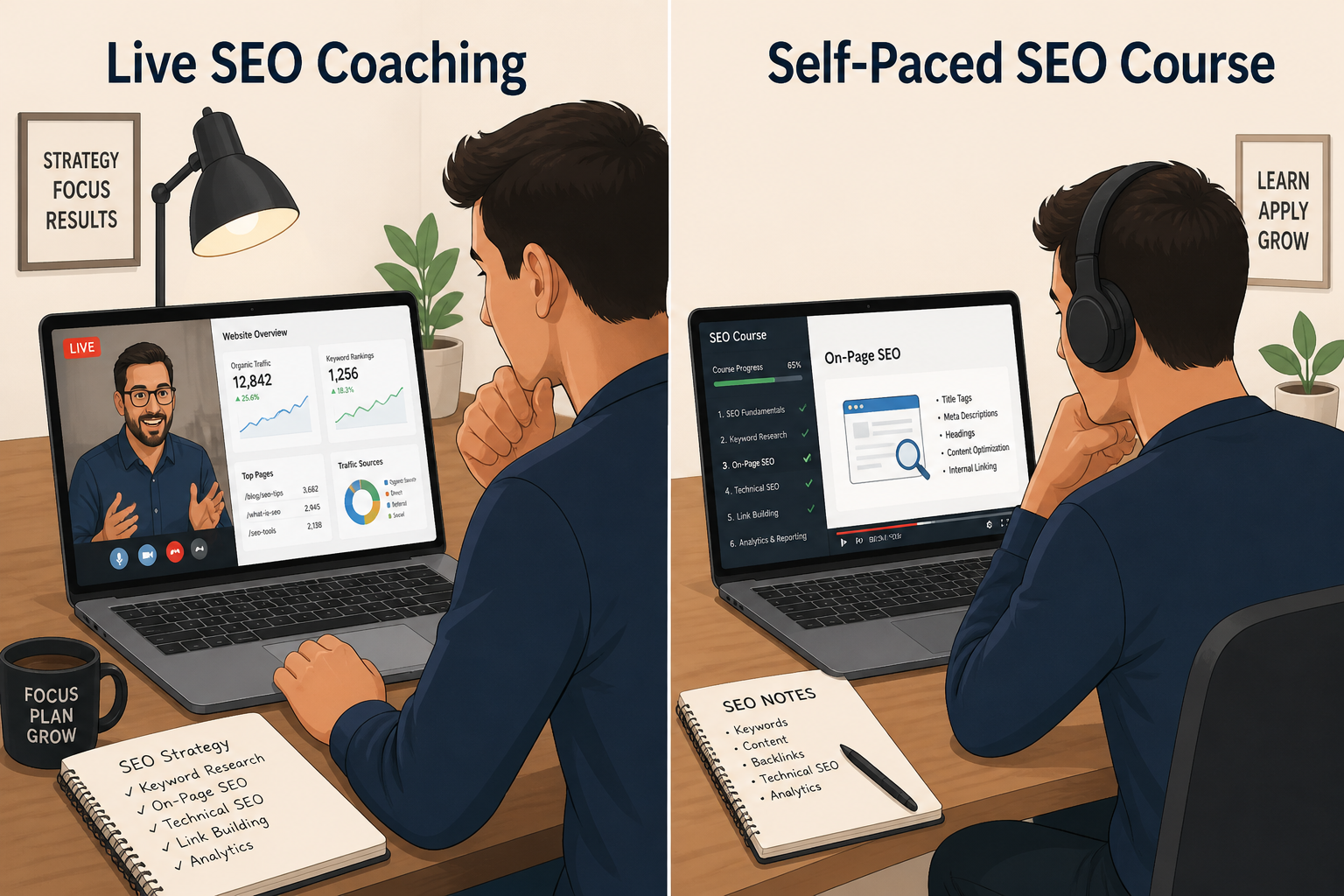
Live SEO coaching means working directly with an experienced SEO coach in scheduled sessions — typically one-on-one or in a small group over video call. Your SEO coach reviews your actual website, identifies what needs fixing, and works through it with you in real time.
Sessions typically run over four to twelve weeks with one or two calls per week. The difference from a standard SEO course is that everything is built around your site and your goals — not a generic example. You can ask questions as they come up, get direct feedback on your on-page SEO and technical SEO, and work through SEO strategies that apply to your specific pages.
Read more about how this works in our guide: SEO Coaching: How It Works + Who It’s For.
What Is a Self-Paced SEO Course?
A self-paced SEO course gives you access to pre-recorded lessons and exercises you complete on your own time. You log in when you have capacity, move through the content at your own speed, and revisit anything you need to review again.
Some of the best free SEO courses — such as the Ahrefs SEO training course and HubSpot’s SEO certification course — are widely used starting points for beginners. Paid SEO courses typically dive deeper and include advanced SEO writing lessons, technical SEO training, and an overall more comprehensive curriculum that guides you from basic SEO to advanced techniques in a logical order.
It can be beneficial to know what you should be learning before you pick your course. Check out SEO Course: What It Covers for a complete list of the curriculum, results, and the audience each course caters to.
Live SEO Coaching — Pros and Cons
Pros
It works on your actual website, not a demo. A good SEO coach applies their SEO knowledge directly to your real pages, your target keywords, and your market. You are not watching someone audit a hypothetical site — you are fixing yours.
You get answers to the right questions. If your SEO efforts are not moving rankings and you cannot work out why, a live session gives you a direct diagnosis. You are not piecing together advice from free resources or guessing which SEO strategies apply to your situation.
Accountability drives real progress. When a session is booked and your SEO coach expects an update, you follow through. This kind of structured SEO learning environment — with built-in accountability — is one of the strongest predictors of SEO success. Most beginners who start a self-paced SEO course stall without that external pressure.
The training adapts as you improve. A knowledgeable SEO coach spends less time on technical SEO topics you struggle with, omits what you already know, and pivots when your goals shift. That tailored education experience is impossible to recreate with a pre-recorded SEO course.
Cons
Higher cost than self-paced options. Live coaching costs more because you are paying for real experience and personalized work — not just course material or hours of video content.
Fixed session schedule. Committing to regular sessions requires a consistent calendar. Missed sessions break the momentum and the overall learning experience.
Quality depends on the trainer’s real-world track record. Someone who holds SEO certifications but has never ranked a website in a competitive space will not give you much practical value. Look for an experienced SEO practitioner who has done the work in the SEO industry — not just someone who built a course.
Self-Paced SEO Training — Pros and Cons
Pros
Complete flexibility. Study when you have capacity — late at night, on a weekend, or in short gaps during the week. Pause and come back whenever needed.
Strong free and paid SEO courses available. Free SEO courses from Ahrefs and HubSpot cover SEO fundamentals well and are a smart, low-risk starting point. Paid SEO courses go further, covering advanced SEO, off-page SEO, and a more comprehensive range of SEO topics. There are now SEO courses online to suit every level and budget — from basic SEO introductions to full beginner to advanced SEO programs.
Works well for foundational SEO knowledge. If you are a true beginner, taking an SEO course allows you to learn how Google SEO functions, learn important SEO concepts that affect ranking, and learn the basics of SEO before jumping into a live site.
Learn without keeping pace with anyone else. No pressure to match a group’s progress or adapt to someone else’s schedule.

Cons
No feedback on your specific site. Traditional SEO course content is built around generic examples that may not match your industry, your website structure, or the local market you operate in. Applying what you learn without guidance is exactly where most people get stuck.
Completion rates are low. Without sessions booked and someone checking in, it is easy to stall. Most beginners who enroll in a self-paced SEO course do not finish it, which means the SEO knowledge they need never gets applied.
You cannot ask the question you actually need to ask. You can work through an entire module on technical SEO and still not understand why your specific page is not being indexed. Without a live SEO coach to ask directly, you stay stuck.
Pre-recorded content can fall behind. Google Search Central releases periodic updates about how search operates. Repurposed SEO course content cannot always stay current, leading to some SEO strategies you learn becoming outdated before you use them. This is one of the few known drawbacks of legacy SEO course offerings.
Free SEO Courses vs Paid SEO Courses — What to Expect

If you are new to the world of SEO and want to test the water, free SEO courses are a practical first move. HubSpot’s SEO certification course and Ahrefs’ SEO training are both widely respected free resources. They cover SEO basics, on-page SEO, link building, and reporting — enough to give you a working understanding of SEO without spending anything.
The best paid SEO courses go further. A comprehensive SEO paid course typically includes technical SEO, advanced SEO strategy, structured course content, and often hours of video content with practical exercises. Some of the best SEO courses online also include community access or coaching calls alongside the course material.
When you are comparing free and paid SEO courses, the key question is not just whether the content is good — it is whether the SEO course is designed to give you practical application, accountability, and guidance on your actual site. The best SEO courses that cover a full range of SEO — from keyword research to SEO and content strategy to technical SEO — are worth the investment if you are serious about mastering SEO.
Do SEO Certifications Matter?

Numerous SEO training courses will give you an SEO certificate or official SEO certification when you finish. These can be helpful if you want tangible proof to show a client or employer that you know SEO, especially if you are just starting your SEO career. They provide evidence that you have completed a comprehensive program and understand the basics of SEO.
That said, SEO certifications are not a substitute for real results. Any SEO specialist or SEO expert worth hiring will be judged on rankings, traffic, and outcomes—not the certificates they hold. For a clear breakdown of which SEO certifications carry real weight and which are mostly for show, read our guide: [SEO Training Certification: What Matters (and What Doesn’t)](link to SEO Training Certification page).
What a Good SEO Course Includes
Regardless of the format you choose, any solid SEO course includes these core areas:
- Keyword research — finding the exact terms your customers search for
- On-page SEO — writing titles, headings, and content that ranks
- Technical SEO — fixing crawl errors, site speed, and mobile issues
- SEO and content strategy — matching your pages to the right search intent at each stage
- Off-page SEO — building links and authority over time
- Tracking and reporting — measuring the results of your SEO strategies using Google Search Console and Analytics
Any SEO course that skips technical SEO or has no section on measurement is not giving you the full picture. For SEO courses that cover both the basics and advanced SEO in the Malaysian market, see: [SEO Course Malaysia: Best Options + How to Choose](link to SEO Course Malaysia).
Structured SEO Courses vs Self-Paced: How to Choose
There is no single right answer. The right choice comes down to where you are now, what you need to achieve, and whether you will actually follow through.
Choose live SEO coaching if:
- You have a live website with pages that should be ranking but are not
- You have worked through free guides and are still stuck applying SEO best practices
- You are a business owner who needs SEO skills that produce results — not just a broader understanding of SEO
- Your team needs SEO training built around your content, your processes, and your market
- You want an experienced SEO coach who can adapt SEO strategies to your specific situation and keep you accountable
For SEO professionals looking to build internal team capability, our [Corporate SEO Training: In-House Program for Marketing Teams](link to Corporate SEO Training) covers exactly this — live, structured training built around your team’s real work.
Choose a self-paced SEO course if:
- You are a beginner starting from zero and want to build SEO knowledge before investing in coaching
- Your budget is tight, and you want to use free SEO courses to build a foundation first
- You have a strong track record of completing self-directed learning
- You are preparing a team member who needs SEO education before taking on more advanced SEO responsibilities
For a detailed look at what a full curriculum covers at each level, see: [SEO Training Course: Curriculum](link to SEO Training Course: Curriculum).
What OKtimize Offers
OKtimize offers an SEO coaching program built around your website from the first session. You bring your real challenges — pages that are not ranking, SEO efforts that have not moved the needle, or a site that Google appears to be ignoring. JY works through them directly with you, covering what needs fixing and why.
This is not a generic SEO course built for a different market. If you are in Malaysia and want live SEO coaching that applies to how Google ranks local and regional sites, that context matters. The goal is SEO success you can measure — higher rankings, more organic traffic, and a team with real SEO skills that last.
If your company qualifies under HRD Corp, live SEO training may also be claimable. See our guide on [SEO HRDF Course Malaysia: HRD Corp-Claimable Training Explained](link to SEO HRDF Course Malaysia) for details on eligibility and the claims process.
Not sure which format fits your situation? Get in touch with JY directly for a free 30-minute consultation. You will leave with a clear view of what your website needs, where your biggest SEO gaps are, and which SEO learning path will actually move things forward.
Frequently Asked Questions (FAQs)
Q1: Can I do SEO training online if I am not technical?
Yes. Most SEO training — both live and self-paced — is designed for people without a coding background. Keyword research, on-page SEO, and content work do not require you to write code. Technical SEO is a learnable area even without a developer background.
Q2: What is the difference between an SEO course and SEO coaching?
A course delivers a fixed curriculum. Coaching is personalized. An SEO coach works on your actual website, applies SEO knowledge directly to your pages, and adapts SEO strategies to your situation. A course gives you SEO knowledge — coaching helps you apply it where it counts.
Q3: Is online SEO training available in Malaysia?
Yes. Live coaching sessions run remotely, so location is not a barrier. OKtimize offers SEO coaching online for business owners and marketing teams across Malaysia. Some programs are eligible for HRD Corp funding.
Q4: Which format gets results faster?
Live coaching tends to produce faster progress because the feedback is specific and the accountability keeps you moving. A self-paced SEO course builds SEO knowledge, but applying it without guidance takes longer — and depends entirely on how consistently you work through it on your own.